
In Moritz Retzsch’s 1831 work The Chess Players, later widely known as Checkmate, a young man sits opposite the Devil.
The Devil wears bright clothes and an even brighter expression of arrogance. He is relaxed, amused and apparently certain that he has won. The young man sits with his head bowed, staring at the chessboard as though it were a gravestone. Between them stands an angel, watching anxiously but unable—or perhaps unwilling—to interfere.
The board rests on what resembles a sarcophagus. Retzsch was not exactly aiming for subtle interior decoration. The game represents a struggle for the young man’s soul.
Everything in the painting announces defeat.
Except, perhaps, the chessboard.
The position is not the expression
A famous story links this painting to Paul Morphy, the extraordinary nineteenth-century American chess player.
According to an anecdote published in the Columbia Chess Chronicle in 1888, Morphy saw a copy of the picture while visiting a private home in Richmond, Virginia. While the other guests saw a defeated young man, Morphy studied the actual position of the pieces.
He reportedly said that he could take the young man’s side and win.
A chessboard was brought, the position was reconstructed and Morphy demonstrated how the apparently lost game might be saved. The popular declaration—“There is one more move!”—appears to be a later, more dramatic version of the story rather than Morphy’s documented words. History, like a good aunt, occasionally improves a story before passing it on.
Whether every detail of the anecdote is historically exact remains uncertain.
But its central insight is worth keeping:
A defeated expression is not proof of a defeated position.
The young man believed the game was over because he could no longer see an escape.
That is not the same thing as there being no escape.
Despair is a poor chess analyst
When we are overwhelmed, the mind can become like a camera using too much zoom. It enlarges the threat until the threat fills the entire screen.
The unpaid bill becomes financial ruin.
The rejection becomes proof that nobody will choose us.
One failed attempt becomes a permanent identity.
One painful chapter quietly applies for the position of “whole life.”
Under acute stress, people can become less mentally flexible and more likely to continue using an old strategy even when it is no longer useful. The brain does not necessarily stop working; it simply begins operating like an anxious security guard—excellent at noticing danger, slightly less talented at imagining alternatives.
This is why despair often speaks in absolutes:
There is no way.
Nothing can change.
It is too late.
I have tried everything.
Usually, “everything” means everything we could imagine while frightened, exhausted and standing inside the problem.
That is a rather small committee.
The Devil’s strongest piece
Perhaps the Devil’s greatest advantage in the painting is not his position on the board.
It is his confidence.
He looks as though the result has already been officially announced. The young man accepts the Devil’s certainty and begins grieving before the game has finished.
This happens outside paintings too.
Manipulative people use certainty.
Fear uses certainty.
Shame uses certainty.
Even our own inner critic speaks with the confidence of an expert who has never once been asked to provide qualifications.
“You cannot recover from this.”
“You have wasted your life.”
“You missed your only opportunity.”
Notice that these voices rarely say, “I may be mistaken.”
Apparently, the internal Devil does not enjoy peer review.
One more move does not always mean victory
The story is often simplified into the comforting message that every situation can be won.
That is not quite true.
Some losses are real. Some doors do close. Some relationships cannot be repaired safely. Some illnesses cannot be wished away, and positive thinking is not a substitute for evidence, treatment or practical action.
“One more move” does not always mean defeating the opponent.
Sometimes the move is asking for help.
Sometimes it is leaving.
Sometimes it is resting until the mind can see clearly again.
Sometimes it is accepting that one game has been lost without deciding that the entire player is lost with it.
And sometimes the bravest move is to stop playing by rules created by someone who benefits from your defeat!!!
Hope is not the childish belief that everything will end exactly as we desire.
Hope is the refusal to let panic make the final diagnosis.
Look at the board again
The angel in Retzsch’s painting does not reach down and move a piece.
Perhaps that matters.
Perhaps the angel represents the part of us that can still witness the situation without becoming identical to it—the quiet awareness that remains present even when the frightened mind has already begun writing the obituary.
The next move still belongs to the young man.
So when life appears to announce checkmate, it may be worth pausing before believing the announcement.
Ask:
Is the position truly hopeless—or am I simply unable to see beyond my present fear?
Am I trapped, or am I exhausted?
Who taught me the rules of this particular game?
What would another pair of eyes notice?
The painting leaves us at the darkest moment: the Devil smiling, the man despairing and the angel waiting.
But perhaps that is precisely where possibility begins.
Not when we are certain of victory.
When we look once more at what appears finished—and notice that something can still move.
Now, take a look at your life and decide—wherever you are, you still have a move.
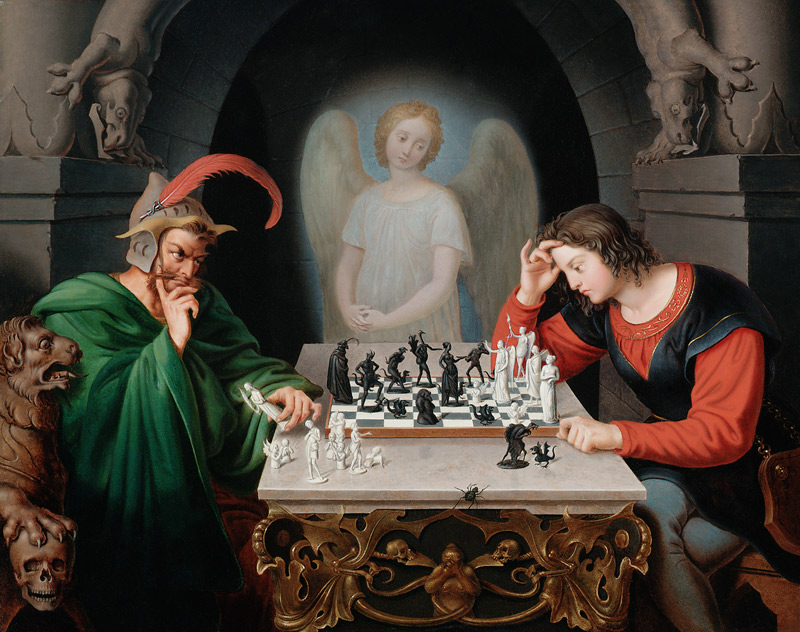
The “Checkmate” painting, also known as “The Devil’s Checkmate” or “Die Schachspieler” (The Chess Players), is an oil painting created by the German artist Friedrich Moritz August Retzsch in 1831.