
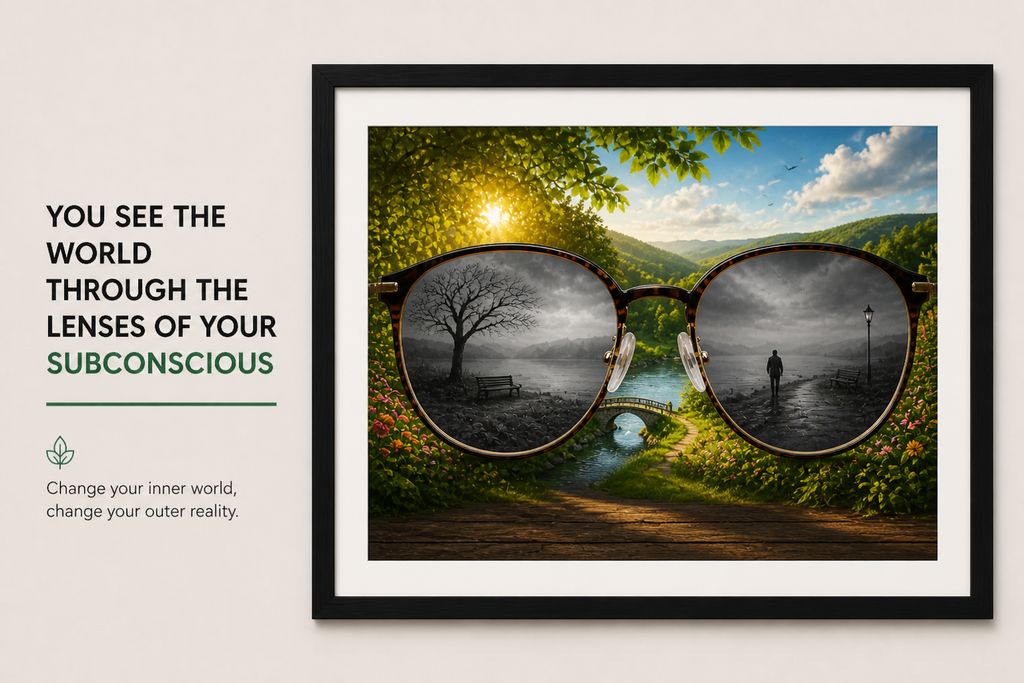
Have you ever wondered why two people can go through the same situation and walk away with completely different stories?
One sees rejection.
The other sees redirection.
One sees criticism.
The other hears useful feedback.
One sees danger.
The other sees opportunity.
Same event. Same room. Same words. Completely different inner experience.
This is where our filters begin.
We often speak as if we all live in the same reality. Technically, we share a physical world — the same streets, the same weather, the same deadlines, the same conversations. But psychologically, emotionally, and even biologically, we do not experience reality in exactly the same way.
We experience reality through filters.
A filter is the inner lens through which we interpret life. It is not only what we see, but how we see it. It is the meaning we give to what happens. It is the story our mind creates from the raw material of life.
And this matters because much of the time, we are responding not only to what happens, but also to our interpretation of what happens.
We Do Not See Reality as It Is
The idea that nobody has direct, pure access to reality may sound dramatic, but it is not meant to suggest that reality does not exist. Of course it does. If you walk into a wall, philosophy will not protect your nose.
The point is more subtle.
We do not meet reality in a clean, neutral, untouched form. We meet it through the nervous system, through memory, through emotion, through expectation, through language, and through the history we carry inside us.
Our personal filters include many things: childhood experiences, education, culture, age, health, emotional wounds, family environment, successes, failures, relationships, professional history, social conditioning, resilience, trauma, fears, beliefs, and even the state of the body on a particular day.
If you are rested, safe, loved, and well-fed, the world may appear more manageable.
If you are exhausted, criticised, under pressure, or emotionally wounded, the same world may feel hostile, overwhelming, or impossible.
That does not mean you are weak. It means you are human.
The mind is not a camera. It does not simply record the world. It selects, prioritises, compares, predicts, and interprets. In psychology and neuroscience, perception is increasingly understood as an active process. The brain does not only receive information from the outside world; it also uses past experience to predict what is happening and what might happen next.
In simple words: your brain is not just receiving life. It is partly predicting what it is seeing based on what it has already learned.
Sometimes that is useful. Sometimes it is tragically inaccurate.
The Map Is Not the Territory
A useful way to understand filters comes from the phrase: “The map is not the territory.”
The phrase comes from Alfred Korzybski and was later adopted within NLP.
The territory is reality itself.
The map is our inner representation of reality.
Your map is made of memories, beliefs, emotional associations, values, fears, desires, and conclusions you have drawn from previous experiences. The problem begins when we forget that our map is only a map.
We confuse our interpretation with truth.
For example, someone does not reply to a message.
One person thinks: “They are busy.”
Another thinks: “They are ignoring me.”
Another thinks: “I must have done something wrong.”
Another thinks: “People always leave.”
The event is simple: no reply.
Some of the suffering can come from the meaning the filter adds.
This is not about blaming ourselves for feeling hurt. It is about noticing the difference between what happened and what we added to what happened.
That distinction is powerful.
Because once you can separate the event from the meaning, you gain space. And in that space, change becomes possible.
Filters Are Not Always the Enemy
It would be easy to say that filters are bad and we should remove them. But that would be too simplistic.
Some filters protect us. Some help us make quick decisions. Some give us taste, personality, creativity, humour, intuition, and wisdom. Without filters, life would be unbearable. We would drown in information.
Imagine walking into a café and consciously processing every sound, every face, every smell, every movement, every possible danger, every possible meaning. The mind has to filter. It has to choose what matters.
The problem is not that we have filters.
The problem is when outdated filters continue to run our lives without our awareness.
A filter that once protected us may later limit us.
A child who grew up around criticism may learn to scan constantly for disapproval. As an adult, this person may hear judgement even where there is none.
Someone who was betrayed may become highly alert to signs of rejection. This may protect them from repeating old pain, but it may also make intimacy difficult.
Someone who failed publicly may avoid visibility, not because they lack talent, but because the nervous system remembers humiliation.
Someone who was taught that rest is laziness may struggle to relax, even when exhausted.
Many of these filters are not random. They can develop through learning and adaptation. At some point, they may have made sense.
But what helped us survive one chapter may prevent us from living the next one.
Emotional Wounds Become Lenses
One of the most important things to understand is that emotional pain does not simply disappear because time has passed.
Time passes. The body remembers.
An emotional wound can become a lens. Past experiences can shape emotional and physiological responses to situations that resemble what happened before, even when the present situation is different.
This is why a calm conversation can feel like an attack.
A small mistake can feel like personal failure.
A boundary can feel like rejection.
A new opportunity can feel dangerous.
Success can feel unsafe.
Love can feel suspicious.
The present moment becomes coloured by the past.
This does not mean the person is “overreacting.” That word is often lazy and unhelpful. A more accurate question is: “What is this reaction connected to?”
The intensity of the response may not belong entirely to the current situation. It may belong partly to an older experience that has not been fully processed.
This is why self-awareness is not a luxury. It is emotional hygiene.
If we do not understand our filters, we may spend years fighting only part of the problem. People, circumstances, money, relationships, age and society can create very real difficulties — while the internal meaning-making system we carry also shapes how we experience and respond to them.
Beliefs Are Filters Too
Some of the strongest filters are beliefs.
A belief is an idea or assumption that we have come to accept as true. Some beliefs become especially powerful through repetition, emotional experience, and reinforcement over time.
“I am not good enough.”
“People cannot be trusted.”
“I have to work hard to deserve love.”
“Money is difficult.”
“If I am visible, I will be criticised.”
“If I rest, I will fall behind.”
“I always have to be strong.”
These beliefs often operate quietly. We may not say them out loud, but we live according to them.
A person who believes “I am not good enough” may overwork, overgive, overprepare, apologise too much, avoid opportunities, or constantly compare themselves with others.
A person who believes “people cannot be trusted” may choose emotional distance and call it independence.
A person who believes “success is unsafe” may sabotage progress every time life starts expanding.
This is where life becomes uncomfortable: sometimes we do not get what we consciously want because another part of us is protecting an older belief.
Consciously, we want love.
Unconsciously, we fear vulnerability.
Consciously, we want success.
Unconsciously, we fear visibility.
Consciously, we want peace.
Unconsciously, we may have become accustomed to urgency because calm feels unfamiliar.
The mind can be very clever. It can create beautiful explanations for old fears.
The Body Also Filters Reality
We often think of filters as purely mental, but our physiological state influences perception too.
When the nervous system is calm, we are more able to think clearly, listen, reflect, and choose our response.
When we perceive threat, attention can narrow and the body can prepare for defensive responses such as fight, flight or freezing. In that state, the world may look more dangerous than it actually is.
This is why stress changes perception.
When we are highly stressed or anxious, we may become more sensitive to possible threat — reading ambiguous expressions more negatively, normal delays as disasters, small mistakes as proof of failure, or silence as abandonment.
The body is not interested in philosophical accuracy. It is interested in survival.
This is also why telling someone “just think positive” is often useless. If the body feels unsafe, positive thinking can feel fake, even insulting.
Real change needs more than affirmations. It can involve awareness, emotional regulation, and sometimes deeper work with learned patterns that keep repeating.
Other People Live Through Their Filters Too
Understanding filters does not only help us understand ourselves. It helps us understand others.
People do not react only to us. They react through their own history.
Their tone, defensiveness, avoidance, criticism, control, silence, or emotional distance may have less to do with us than we think. This does not excuse harmful behaviour, but it can help us stop personalising everything.
Someone’s reaction may be about their fear.
Their judgement may be about their conditioning.
Their need for control may be about their insecurity.
Their emotional coldness may be a protective strategy.
Again, this does not mean we should accept poor treatment. Compassion without boundaries becomes self-abandonment. But understanding filters can help us respond with more clarity and less emotional chaos.
We can ask: “Is this about me, about them, or about both of us?”
That question alone can save a lot of unnecessary suffering.
Can We Change Our Filters?
Yes — but not by pretending they are not there.
The first step is noticing them.
A useful question is: “What am I making this mean?”
Not: “What happened?”
But: “What meaning did I attach to what happened?”
For example:
“What am I making this silence mean?”
“What am I making this mistake mean?”
“What am I making this person’s tone mean?”
“What am I making this delay mean?”
“What am I making this opportunity mean?”
This question interrupts the automatic story.
Another useful question is: “Is this current reality, or is an old wound interpreting the present?”
That question is not comfortable. But it is honest.
Awareness does not instantly dissolve every filter, but it weakens the illusion that our first interpretation is always the truth.
From there, we can begin to update the map.
This is where therapeutic work can become useful. Different approaches may explore different parts of the pattern.
CBT can help us examine the thoughts, interpretations and beliefs behind our reactions.
In my integrative work, I may also use imagery, reframing and other techniques drawn from NLP to explore how someone structures meaning and inner experience, while recognising that NLP itself has a more limited research base.
Hypnotherapy can offer another way of working with attention, imagery, suggestion, emotional responses and learned patterns that may operate more automatically.
The purpose is not to become a different person.
The purpose is to stop living through old conclusions that no longer serve us.
A More Honest Way to See
We may never perceive reality in a completely pure, objective way. Perhaps no human being can.
But we can become more aware of the lenses we are wearing.
We can notice when fear is colouring the picture.
We can notice when shame is writing the story.
We can notice when the past is speaking louder than the present.
We can notice when our nervous system is calling something dangerous simply because it is unfamiliar.
And little by little, the world begins to change — not because the world has magically transformed, but because the inner lens has become clearer.
This is not about forcing positivity. It is about developing accuracy.
Because sometimes healing is not about creating a new life from nothing.
Sometimes healing begins with asking a quieter, braver question:
“Am I seeing what is really here, or am I seeing what my history taught me to expect?”
That question can become a bridge.
A bridge between reaction and awareness.
Between old pain and present choice.
Between the life we inherited and the life we are finally ready to create.
References / Further Reading
Peelen, M. V., Berlot, E., & de Lange, F. P. (2024). Predictive processing of scenes and objects. Nature Reviews Psychology, 3, 13–26.
Bar-Haim, Y., Lamy, D., Pergamin, L., Bakermans-Kranenburg, M. J., & van IJzendoorn, M. H. (2007). Threat-related attentional bias in anxious and nonanxious individuals: A meta-analytic study. Psychological Bulletin, 133(1), 1–24.
Zahedi, A., Lynn, S. J., & Sommer, W. (2024). How hypnotic suggestions work – A systematic review of prominent theories of hypnosis. Consciousness and Cognition, 123, 103730.
Sturt, J., et al. (2012). Neurolinguistic programming: a systematic review of the effects on health outcomes. British Journal of General Practice, 62(604), e757–e764.